
India has been a major destination for outsourced software work for decades, and the reasons are well known: a large engineering talent pool, mature delivery practices and cost advantages. What has changed is the work itself. Buyers now come to Indian partners for AI products, cloud-native platforms and long-term product engineering, not just maintenance.
That raises the stakes on choosing well. This guide to offshore software development in India covers engagement models, the real costs, the risks that sink projects and a checklist for evaluating partners.
Why companies choose India for offshore development
- Talent depth: large numbers of engineers across modern stacks such as .NET, Java, Python, Node.js, mobile and cloud.
- Cost efficiency: lower blended rates than onshore teams in the US, UK or Western Europe, though the gap narrows for senior and specialist roles.
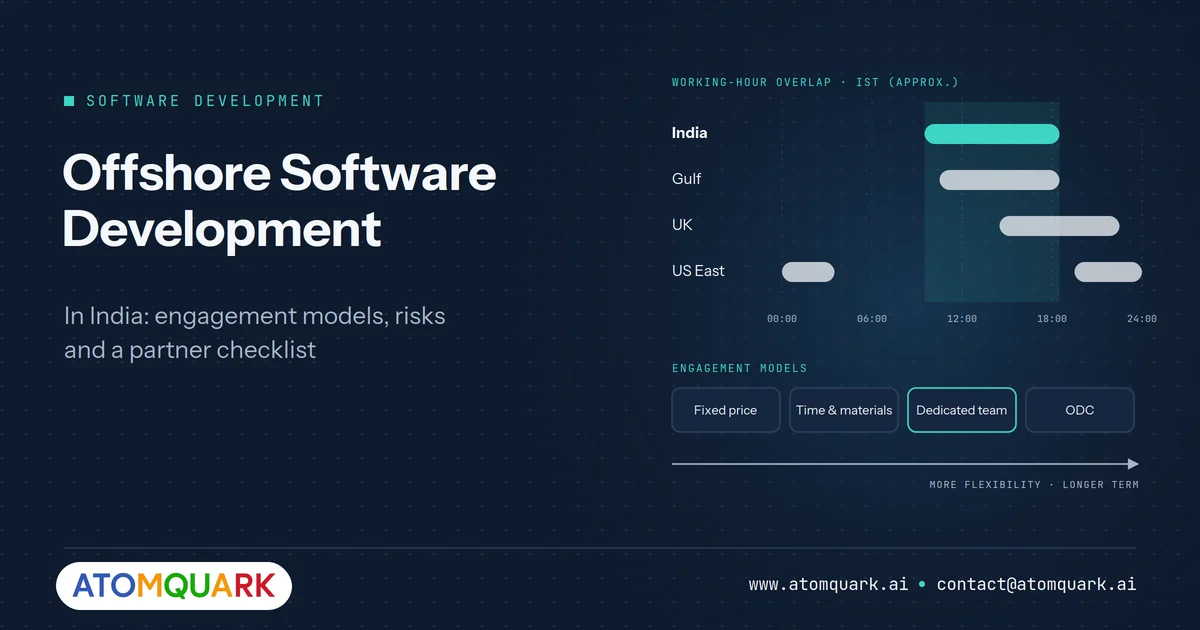
- Time-zone coverage: India overlaps with the UK and Europe working day and can provide overnight progress for US teams.
- Mature delivery practices: Agile and Scrum, DevOps and established QA practices are standard among serious providers.
Cost should not be the only reason. Teams that choose purely on hourly rate often pay more in rework.
Engagement models compared
Fixed price
Agreed scope, price and timeline. Works for small, well-defined projects. Struggles when requirements change, because every change becomes a negotiation.
Time and materials
You pay for actual effort. Flexible and suited to evolving products, but needs active product ownership on your side to keep scope under control.
Dedicated team
A team of engineers works only on your product, managed day to day by you or jointly. Good for ongoing product development where knowledge continuity matters.
Offshore development centre (ODC)
A larger, longer-term setup that operates as an extension of your engineering organisation, often with its own processes, tooling and leadership. Suited to companies scaling engineering significantly.
Rule of thumb: fixed price for a defined MVP, then dedicated team or time and materials as the product evolves.
The real cost of offshore development
Hourly rates are only part of the picture. Budget for:
- Discovery and requirements work before development
- Product ownership time from your side (often underestimated)
- QA and testing, ideally automated from the start
- DevOps and cloud costs
- Knowledge transfer and documentation
- Ongoing maintenance and support after launch
For whether to build at all, our build-vs-buy framework compares custom software with off-the-shelf options over a three-to-five-year total cost of ownership.
Risks and how to manage them
Communication gaps
Mitigation: fixed overlap hours, a named delivery lead, written sprint goals and demos every sprint.
Quality problems discovered late
Mitigation: require automated testing, code review and CI/CD from sprint one. Ask to see the pipeline, not just a slide about it.
Hidden dependency on the vendor
Mitigation: your organisation should own the code repository, cloud accounts and documentation from day one.
Security and IP
Mitigation: clear IP assignment in the contract, NDAs, least-privilege access to your systems, and evidence of security practices such as SOC 2 or ISO 27001 alignment.
Staff turnover
Mitigation: ask about retention, knowledge-sharing practices and how replacements are onboarded.
A checklist for choosing an Indian development partner
- Relevant work: have they built something similar in your domain, and can you speak to a client?
- Live products: can they show software running in production, not just prototypes?
- Engineering practices: Agile cadence, code review, automated testing, CI/CD and documentation.
- Technology fit: genuine depth in your stack, not a list of every framework.
- AI capability: if relevant, experience shipping AI features to production, with sensible governance.
- Security posture: access control, secure development practices and data handling.
- Transparency: clear estimates, visible progress and honest reporting of problems.
- Commercial clarity: IP ownership, exit terms and change-request process in writing.
Before scaling a vendor relationship or acquiring a product built offshore, an independent review is worthwhile. See our guide to technical due diligence and product audits.
How AI is changing offshore delivery
AI-assisted development is now part of how good teams work: requirements analysis, code generation, test creation and review. Used well, it speeds delivery while engineers stay accountable for decisions. Used carelessly, it produces code nobody understands. Ask prospective partners how they use AI in their lifecycle and what guardrails they apply. We describe one approach in our article on the AI-driven SDLC.
Onboarding an offshore team in the first 30 days
The first month shapes the whole engagement. Plan it as carefully as the build.
- Week 1: access and context. Grant access to the repository, ticketing tool, communication channels and test environments, all under your ownership. Share the product vision, user personas and the reasons behind key decisions, not just the backlog.
- Week 2: ways of working. Agree sprint length, ceremonies, the definition of done, code review rules, branching strategy and how blockers are escalated. Write these down in a short working agreement.
- Week 3: first delivery. Aim for a small, real piece of functionality deployed to a test environment through the agreed pipeline. It proves the workflow end to end.
- Week 4: review and adjust. Hold a retrospective covering communication, estimation accuracy and quality. Fix friction now, while habits are still forming.
Assign a product owner on your side with real decision-making authority and time in the overlap hours. The most common cause of offshore project delays is waiting for answers, not slow coding.
Contract terms worth getting right
Before signing, confirm the contract covers:
- IP assignment of all code, designs and documentation to your company on payment
- Confidentiality obligations that continue after the engagement ends
- Data protection responsibilities, especially if the team will access personal data
- Staffing commitments, including named key people and notice before changes
- Acceptance criteria for deliverables and how defects are handled
- Change request process with clear pricing rules
- Exit and transition support, including handover of code, documentation and credentials
- Governing law and dispute resolution that both parties can work with
Have the contract reviewed by a lawyer familiar with cross-border technology agreements.
Signs the partnership is working
After three months, a healthy engagement shows steady sprint delivery, falling defect rates, estimates that become more accurate over time, and a team that raises risks before you notice them. If you are still discovering problems in demos rather than hearing about them in advance, address it directly.
About Atomquark.ai
Atomquark Software LLP is based in Faridabad, Haryana, and works with clients across Finland, India, Saudi Arabia and beyond. Atomquark's custom software development services cover web, mobile and enterprise applications with Agile and Scrum delivery, an AI-driven SDLC, enterprise backends in .NET, Python, Java, Spring Boot, PHP and Node.js, multi-cloud DevOps on Azure, AWS and GCP, and QA and testing.
Atomquark's own products, including warranty management live at HMD Global and an AI traffic enforcement system in Hazen, KSA, are built and run in production by the same engineering team. Client work is documented in Atomquark's case studies.
Frequently Asked Questions
Why is India popular for offshore software development?
India offers a large engineering talent pool, mature delivery practices, cost advantages and useful time-zone overlap with Europe and the Middle East.
What is the best engagement model for offshore development?
Fixed price suits small, well-defined projects. Dedicated teams or time-and-materials models suit evolving products that need flexibility and continuity.
How do I protect my IP when outsourcing to India?
Use contracts with clear IP assignment and NDAs, keep code repositories and cloud accounts under your ownership, and grant least-privilege access to your systems.
How do I manage time-zone differences with an Indian team?
Agree on fixed overlap hours, use written sprint goals and asynchronous updates, and hold regular demos.
What should I check before hiring an offshore development company?
Relevant experience, live production work, engineering practices, security posture, transparent reporting and clear commercial terms.
Build with a team that runs its own products in production
Contact Atomquark.ai to discuss your project, engagement model and timeline.