
For most product companies, warranty is a cost line nobody owns end to end. Service partners submit claims, someone checks them, finance pays them, and quality teams get a report months later. Each handoff adds delay, cost and room for error, and occasionally room for fraud.
A well-designed warranty claims process turns that into a controlled, measurable flow. This guide maps the seven steps, shows where money typically leaks, and explains which steps are worth automating first.
Why the warranty claims process deserves attention
Warranty touches more of the business than it appears to:
- Finance: every approved claim becomes a payment or credit to a service partner.
- Customer experience: slow approvals mean slow repairs.
- Quality: claims are the earliest large-scale signal of product failures.
- Supply chain: claim volumes drive spare parts demand.
When the process is manual, all four suffer. When it is structured and data-driven, the same claims become a source of insight.
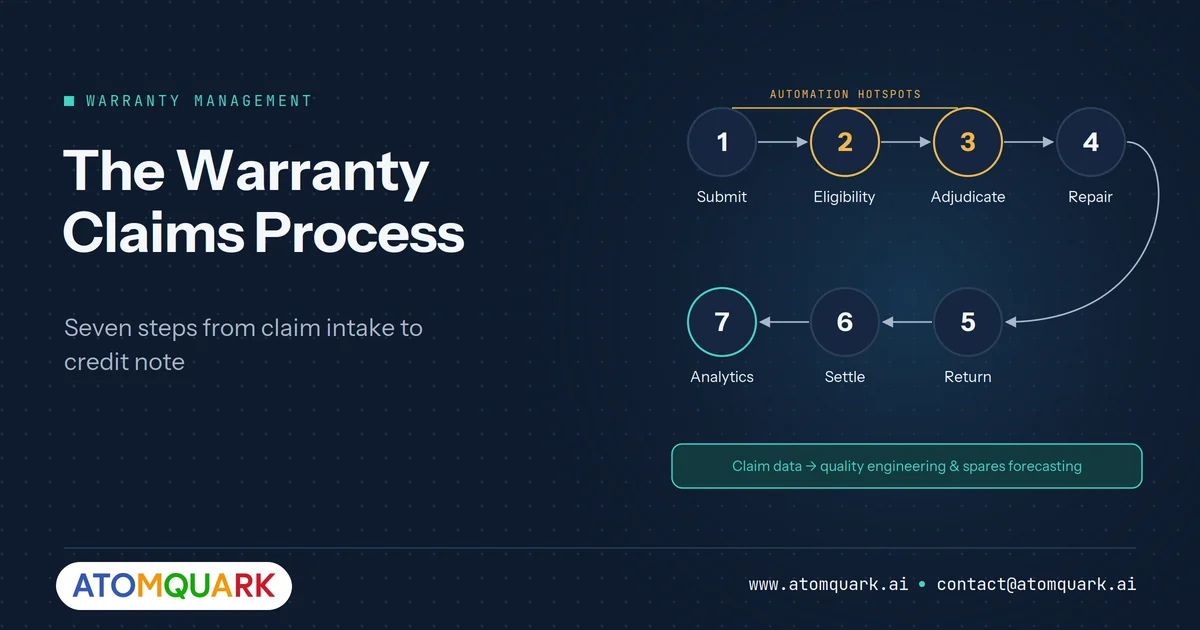
The warranty claims process in 7 steps
Step 1: Claim submission
The authorised service partner (or the customer, for direct claims) submits the claim with product identifier (serial number or IMEI), purchase or activation date, fault description, parts used, labour and supporting documents.
Where it goes wrong: free-text fault descriptions, missing invoices and photos, and inconsistent formats across countries. Enforce required fields and standard fault codes at the point of entry.
Step 2: Eligibility and coverage check
Is the product within its warranty period? Is the fault covered? Was the product sold in this market? Has it already been swapped?
Where it goes wrong: checking eligibility by hand against spreadsheets. This is slow and inconsistent between reviewers. Eligibility should be looked up automatically against product master data and activation records.
Step 3: Adjudication
The claim is approved, rejected or sent for review based on business rules: labour rates per country, allowed parts per fault code, repair vs swap policies and claim value thresholds.
Where it goes wrong: every reviewer applies rules slightly differently, and rule changes take weeks to reach everyone. Codifying rules in a rules engine makes decisions consistent and auditable. We cover this in depth in automating warranty claim adjudication.
Step 4: Repair, replacement or swap
The service partner completes the repair or the unit is swapped according to the approved decision. Parts consumption is recorded against the claim.
Step 5: Parts return and inspection
For selected claims, failed parts are returned for inspection. This both verifies the claim and feeds root-cause analysis.
Step 6: Settlement and credit notes
Approved claims become credit notes or invoices to the service partner, then post into the ERP.
Where it goes wrong: finance teams rebuilding claim data into ERP upload files by hand. This step alone can add days to every cycle.
Step 7: Analytics and feedback
Claim volumes, approval rates, cost per claim and failure trends by model, region and partner flow back to quality, product and supply chain teams. Claims data is one of the strongest inputs to spare parts demand forecasting.
Spotting warranty fraud and leakage
Not all excess cost is fraud. Much of it is leakage: honest mistakes, outdated rate cards and policies applied inconsistently. Common patterns worth monitoring include:
- Duplicate claims on the same serial number or IMEI
- Out-of-period claims that slip through manual date checks
- Part inflation: more parts per repair than the fault code justifies
- Labour inflation: labour times consistently above norms for a partner
- Unusual partner patterns: one service centre with approval or cost metrics well outside its peers
Rules catch the first two reliably. The last three need analytics that compare each partner against the network.
Which steps to automate first
If you can only automate two things, automate eligibility and settlement. Eligibility checks are high-volume and purely data-driven. Settlement is where finance time disappears. Adjudication rules come next, followed by analytics.
A practical sequence:
- Centralise product, pricing and country tax data in one master data source.
- Connect eligibility checks to that master data and to activation records.
- Encode adjudication rules and approval thresholds.
- Auto-generate credit notes in a format your ERP can ingest.
- Build dashboards on the resulting clean data.
How Atomquark Warranty Management supports the process
Atomquark Warranty Management automates this flow end to end. Its claims adjudication engine applies business rules and checks eligibility through integration with the manufacturer's warranty systems. Approved claims automatically generate credit notes and invoice proposals in an ERP-ready format for SAP S/4HANA upload. A master data module centralises product configuration, pricing, country taxation and swap rules, and analytics dashboards track claim volumes, approval rates and credit note values, with OCR extraction from unstructured claim documents.
The platform is live at HMD Global, covering more than 70 countries. For brands that would rather not run warranty operations in-house, Atomquark also offers it as a managed model, explained in our Warranty as a Service guide.
Building a claim data standard
Most warranty problems trace back to inconsistent claim data. A written data standard, enforced at submission, fixes this at the source. At minimum, define:
- Product identity: serial number or IMEI, model, variant and country of sale
- Dates: purchase or activation date, failure date, repair date
- Fault coding: a controlled list of symptom codes and cause codes, rather than free text
- Repair details: action taken (repair, part replacement, swap), parts used by part number, labour time
- Evidence: proof of purchase where required, photos, diagnostic logs
- Partner details: service centre ID, technician ID, claim reference
Publish the standard to every service partner with examples of complete and incomplete claims. Reject incomplete claims automatically with a clear reason, rather than letting reviewers chase missing information by email.
Working with service partners
Service partners are not just claim submitters. They are your brand's face to customers after the sale, and the process should help them perform well.
- Onboard properly. Train new partners on the data standard, fault codes and submission system before they submit their first claim.
- Share scorecards. Give each partner a regular view of their own metrics compared with network averages: approval rate, cost per claim, repeat repairs and turnaround time. Most partners improve once they can see where they stand.
- Pay on time. Fast, predictable settlement builds goodwill and reduces disputes. Partners who wait months for credit notes have little incentive to follow your rules carefully.
- Run a clear dispute process. When a claim is rejected, partners should see the reason and have a defined route to appeal. Track overturned rejections, because a high overturn rate suggests rules that need fixing.
- Act on outliers fairly. When a partner's metrics are well outside the norm, start with a conversation and a review of sample claims before assuming fraud. Often the cause is training, a local product issue or a misunderstanding of policy.
Metrics that show the process is working
- Average claim cycle time (submission to settlement)
- First-pass approval rate
- Average cost per claim, by partner and region
- Claims requiring manual review (should fall over time)
- Rejected claims overturned on appeal (a sign rules are too strict)
- Days from approval to credit note
Frequently Asked Questions
What are the steps in a warranty claims process?
Claim submission, eligibility and coverage check, adjudication, repair or replacement, parts return and inspection, settlement through credit notes, and analytics feeding quality and supply chain teams.
How long should a warranty claim take to process?
It varies by industry and policy. The goal is to shorten each stage, especially eligibility checks and settlement, which are the most automatable.
What is warranty adjudication?
Adjudication is the decision step where a claim is approved, rejected or sent for review based on coverage, fault code, labour rates and parts rules.
How can manufacturers reduce warranty costs?
By enforcing complete claim data at submission, automating eligibility, applying adjudication rules consistently, monitoring partner patterns for leakage, and using claim data to fix root causes in product quality.
What does warranty management software do?
It manages the full claim lifecycle: intake, eligibility, rules-based adjudication, settlement and analytics, typically integrated with ERP and product master data.
Turn warranty into a controlled process
Consistent decisions, faster settlement and clean data for quality teams. Request a Warranty Management demo to see the process running at global scale.