Ask a general-purpose language model about your returns policy and it will give you a confident, plausible and probably wrong answer. It has never seen your returns policy. Enterprise RAG fixes that by fetching the right internal documents first and handing them to the model as evidence.
Retrieval-augmented generation is now the default pattern for internal knowledge assistants, support bots and document Q&A. It is also easy to build badly. This guide explains how it works, where it goes wrong, and what a production-grade pipeline needs.
What is retrieval-augmented generation?
Retrieval-augmented generation (RAG) is a technique that retrieves relevant passages from a knowledge source and includes them in the model's prompt so the answer is grounded in that content. The approach was formalised in a 2020 research paper by Lewis and colleagues, Retrieval-Augmented Generation for Knowledge-Intensive NLP Tasks, and has since become a standard enterprise architecture.
In plain terms: search first, then write the answer using only what the search found.
How an enterprise RAG pipeline works
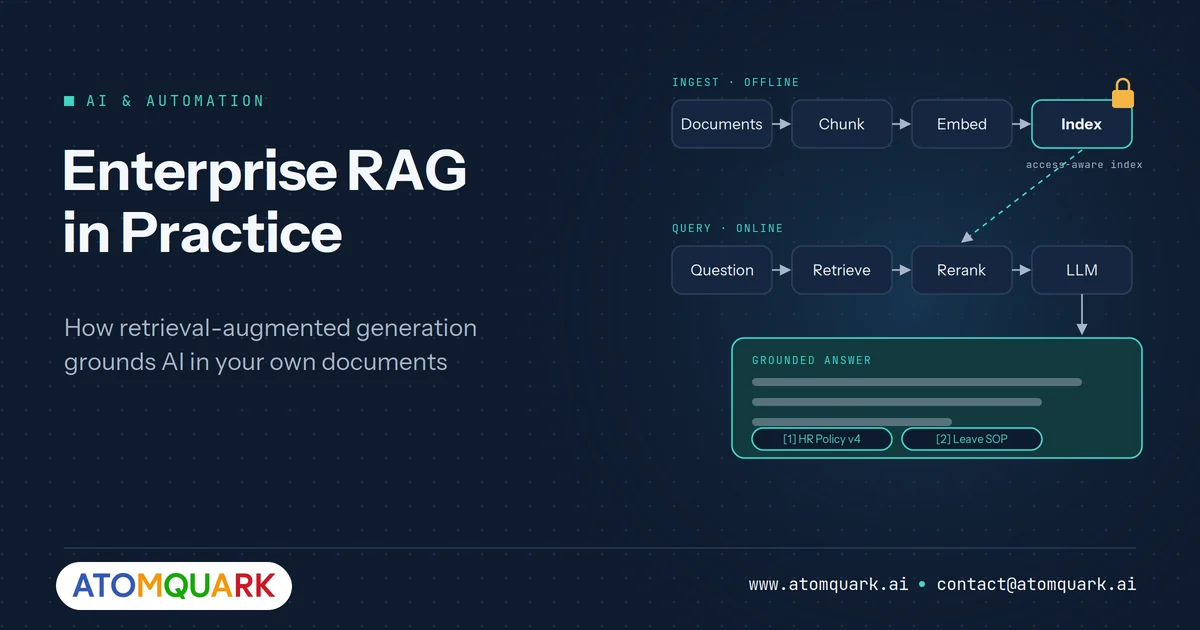
A RAG system has two halves. One runs ahead of time; the other runs each time someone asks a question.
The ingestion pipeline (offline)
- Collect documents from SharePoint, Confluence, drives, ticketing systems and databases.
- Clean and parse them. PDFs with tables, scanned forms and slide decks need different parsers. Bad parsing is the most common hidden cause of bad answers.
- Chunk each document into passages. Chunks that are too small lose context; chunks that are too large dilute relevance.
- Embed each chunk into a vector that captures its meaning.
- Index the vectors with metadata: source, date, department and, critically, who is allowed to see it.
The query pipeline (online)
- The user's question is embedded the same way.
- The system retrieves the most similar chunks, usually combining vector search with keyword search (hybrid retrieval) to catch exact terms like part numbers.
- A reranker reorders the results by relevance.
- The top passages go into the prompt with an instruction to answer only from them and cite sources.
- The model returns an answer with citations the user can click to verify.
RAG vs fine-tuning: which do you need?
This is the question we hear most. They solve different problems.
- RAG changes what the model knows at answer time. Use it when information changes often, must be cited, or is restricted by user permissions.
- Fine-tuning changes how the model behaves. Use it to teach tone, format or specialised task patterns, such as always producing output in a set schema.
For most enterprise knowledge use cases, start with RAG. It is cheaper to update (re-index a document instead of retraining), easier to audit (every answer has a source) and respects access controls. Fine-tuning a small model on top of RAG can make sense later, especially when you want to run privately at lower cost, a trade-off we cover in small language models vs LLMs.
Five reasons enterprise RAG projects underperform
1. Poor document quality
If your source documents contradict each other, the assistant will too. Assign owners to key documents and retire outdated versions before indexing.
2. Ignoring permissions
If the index does not carry access controls, a junior employee can ask the bot about salary bands and get an answer. Filter retrieval by the user's identity on every query.
3. Pure vector search
Embeddings are good at meaning and weak at exact identifiers. Hybrid search fixes most "it couldn't find SKU 4471-B" complaints.
4. No evaluation set
Without a fixed set of test questions and expected answers, you cannot tell whether a change made things better or worse. Build 100–200 real questions from support logs before launch.
5. No "I don't know"
Instruct the model to say when the retrieved context does not contain the answer. A clear "I couldn't find that in our policies" is far more useful than a confident invention.
Security and data residency
Enterprise RAG means sending internal documents to a model. Decide early where that model runs. Options range from a managed cloud API with contractual data protections to private, on-premise AI where documents never leave your infrastructure. Regulated industries often choose the latter.
Also log every query and retrieved source. If an answer causes a problem, you need to know which document it came from.
How to measure RAG quality
Track retrieval and generation separately, because they fail separately.
- Retrieval hit rate: did the correct passage appear in the top results?
- Faithfulness: does the answer only state what the sources say?
- Answer relevance: does it actually address the question?
- Citation accuracy: do the cited passages support the claim?
- Business outcome: ticket deflection, handling time, or time saved per search.
Our guide to enterprise AI chatbots that deflect tickets shows how to tie these metrics to support outcomes honestly.
Chunking and retrieval choices that matter
Small design decisions in the pipeline have an outsized effect on answer quality.
- Chunk by structure, not by character count. Split documents at headings, sections and table boundaries so each chunk is a complete thought. A policy clause cut in half produces half an answer.
- Keep some overlap. A short overlap between neighbouring chunks prevents important sentences from being separated from their context.
- Store rich metadata. Source, version, owner, department, effective date and access group allow filtering ("only current HR policies for India") before similarity search even begins.
- Treat tables differently. Convert tables to a structured text form, or index them separately, so numbers stay attached to their row and column labels.
- Tune how many passages you retrieve. Too few and the answer misses context; too many and the model is distracted by marginal passages. Use your evaluation set to find the right number.
- Rerank before generating. A reranking step that scores each retrieved passage against the question usually improves precision more cheaply than switching to a larger model.
What enterprise RAG costs to run
Exact costs depend on document volume, query volume and hosting choices, so treat any vendor quote that skips these variables with caution. The main cost drivers are:
- Ingestion and parsing: compute for converting, cleaning and chunking documents, heavier for scanned files that need OCR.
- Embedding: generating vectors for every chunk on first load, then for every new or changed document.
- Vector storage and search: grows with the number of chunks and the query rate.
- Generation: model usage per query, driven by how much retrieved text is placed in each prompt.
- Evaluation and maintenance: the human time to review answers, update the test set and keep source documents current.
The last item is the one most budgets forget. A RAG system is only as current as its documents, so someone must own content freshness. Running smaller models privately can lower per-query costs at high volumes, while managed APIs are often cheaper for low or unpredictable volumes.
A six-week RAG pilot plan
- Weeks 1–2: scope and collect. Pick one domain, such as HR policies or product support documentation. Gather the documents, name an owner for each, and remove outdated versions. Collect 100–200 real questions from tickets, chats or email.
- Week 3: build the pipeline. Parse, chunk, embed and index the documents with access metadata. Set up hybrid retrieval and reranking.
- Week 4: evaluate. Run the question set, score retrieval hit rate and faithfulness, and fix the worst failures, which are usually parsing or chunking problems rather than model problems.
- Week 5: limited release. Give access to a small group of real users with a feedback button on every answer.
- Week 6: decide. Compare results with the baseline (time to find an answer, tickets raised, user ratings) and decide whether to expand to more documents and users.
Where RAG fits in your stack
RAG is a component, not a product. It powers internal search assistants, customer-facing support bots, agent-assist tools in a helpdesk such as SupportDesk, and the knowledge layer inside AI agents for business.
Atomquark's AI as a Service builds and runs RAG pipelines, including document Q&A and semantic search on small language models deployed on-premise or in a private cloud, so teams get grounded answers without building an ML platform from scratch.
Frequently Asked Questions
What does RAG stand for in AI?
RAG stands for retrieval-augmented generation, a method that retrieves relevant documents and supplies them to a language model so its answer is grounded in that content.
Is RAG better than fine-tuning?
For knowledge that changes often or needs citations and access control, RAG is usually the better first choice. Fine-tuning is better for teaching consistent behaviour, tone or output format. Many systems use both.
Does RAG eliminate hallucinations?
It reduces them significantly but does not eliminate them. Good retrieval, instructions to answer only from sources, citations and an explicit "I don't know" path all help.
What is a vector database used for in RAG?
It stores numerical embeddings of document chunks and finds the passages most similar in meaning to a user's question.
Can RAG run on-premise?
Yes. Embedding models, vector stores and small language models can all run on private infrastructure, keeping documents inside your network.
Build a RAG assistant your team will trust
Grounded answers, permission-aware retrieval and a measurable quality bar. Contact Atomquark.ai to scope a private RAG pipeline for your documents.