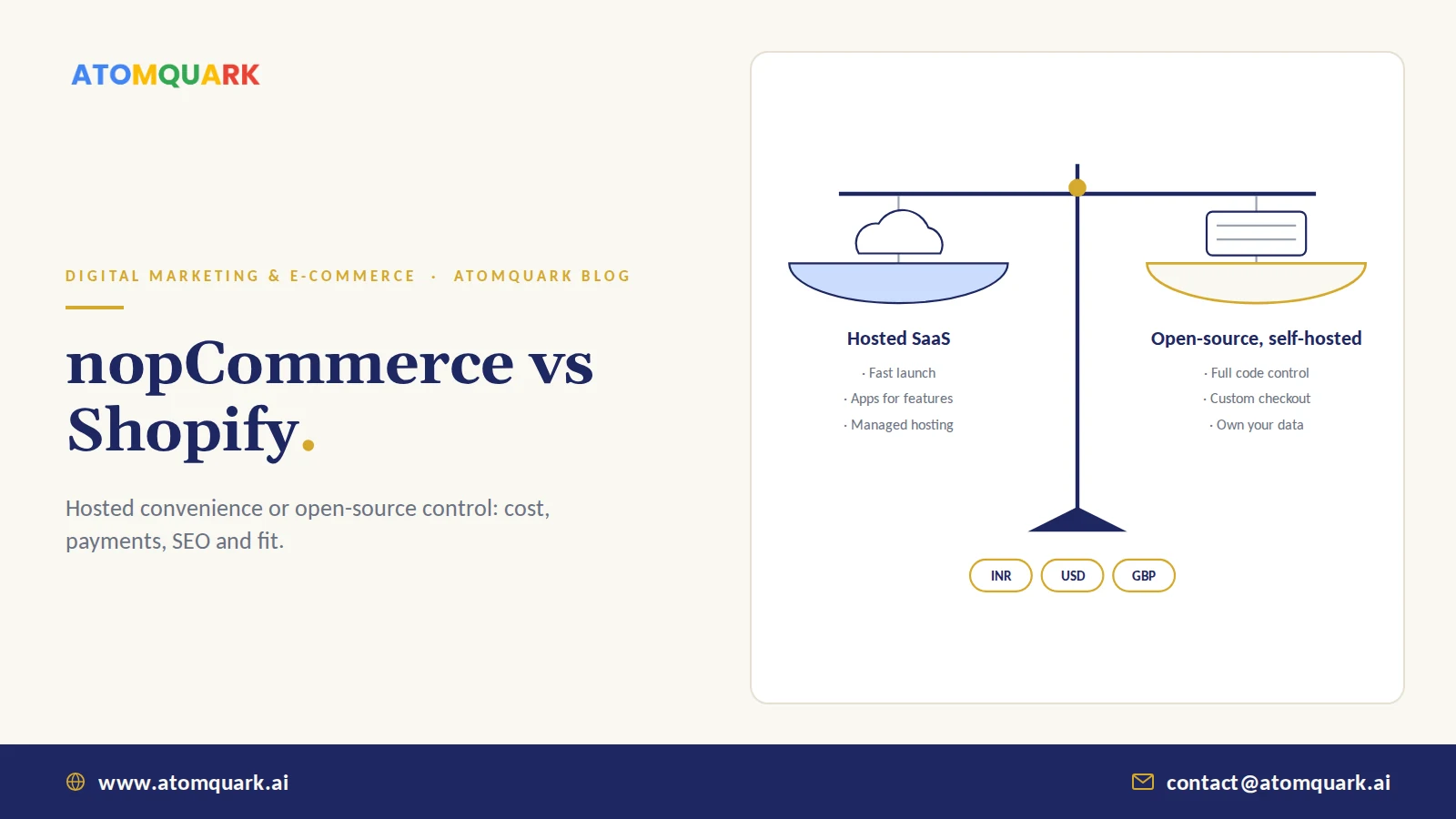
nopCommerce vs Shopify is a choice between two different models. Shopify is a hosted, subscription-based e-commerce platform: quick to launch, maintained for you, extended through an app store. nopCommerce is a free, open-source e-commerce platform built on Microsoft's ASP.NET Core: you or your partner host and customise it, which gives you full control over code, data and checkout at the cost of more technical responsibility.
Neither is "better" in general. Shopify wins for speed and simplicity. nopCommerce wins when you need deep customisation, own-infrastructure hosting, or want to avoid stacking monthly app fees and platform transaction charges.
We build on both, so here's the honest comparison.
Quick verdict: Launching fast with standard needs and a small team? Shopify. Need custom checkout logic, complex catalogues, full data ownership or a .NET-based stack? nopCommerce.
What Is Shopify?
Shopify is a fully hosted SaaS platform. You pay a monthly plan, pick a theme, add apps for extra features, and Shopify handles hosting, security patches, PCI compliance for its checkout and uptime. Shopify Plus serves high-volume brands.
Best at: speed to launch, ease of use for non-technical teams, a huge app and theme ecosystem.
What Is nopCommerce?
nopCommerce is an open-source platform written in C# on ASP.NET Core. The software itself is free; you pay for hosting, development and any premium plugins or themes. It supports multi-store, multi-vendor and multi-currency setups out of the box.
Best at: customisation, control over data and hosting, and fitting into Microsoft-based enterprise environments.
nopCommerce vs Shopify: Head-to-Head
- Licence and model — Shopify: hosted SaaS subscription. nopCommerce: free, open-source; self or partner hosted.
- Time to launch — Shopify: days to weeks. nopCommerce: weeks to months.
- Technical skill needed — Shopify: low. nopCommerce: moderate to high (.NET).
- Customisation — Shopify: themes, apps, limited checkout changes on standard plans. nopCommerce: full source code access.
- Hosting and data — Shopify: Shopify-hosted. nopCommerce: your choice of cloud or servers.
- Ongoing costs — Shopify: plan + apps + possible transaction fees. nopCommerce: hosting + development + maintenance.
- Multi-store / multi-vendor — Shopify: via plans and apps. nopCommerce: built in.
- Security and updates — Shopify: managed by Shopify. nopCommerce: your or your partner's responsibility.
Total Cost of Ownership: Look Beyond the Sticker Price
Shopify costs start low, but grow with apps (subscriptions for reviews, subscriptions commerce, loyalty, advanced filters), and, if you use a third-party payment gateway instead of Shopify Payments, an extra transaction fee on each sale. Shopify Payments isn't available in every country, so check whether it's offered where you sell. Check the platform's current pricing for your country before deciding.
nopCommerce has no licence fee or platform transaction fee, but you pay for development, hosting, monitoring, updates and security. The upfront investment is higher; the long-term running cost can be lower at scale or with complex requirements.
Model three to five years, not three months. Our custom software vs off-the-shelf framework applies directly here.
Payments and Multi-Currency Selling
Cross-border D2C brands need local payment options. Both platforms can handle INR, USD and GBP checkouts and gateways such as Razorpay, PayU and Stripe, with differences in how:
- Shopify uses its built-in multi-currency features (strongest with Shopify Payments) plus gateway apps.
- nopCommerce supports multiple currencies natively and gateways through plugins or custom integration, giving full control over checkout flow.
Atomquark's e-commerce development team has built nopCommerce storefronts for D2C wellness and FMCG brands with INR/USD/GBP checkout and Razorpay, PayU and Stripe integration. For the wider growth playbook, see cross-border D2C e-commerce across the USA, India and UK.
SEO Capabilities
Both platforms can rank well. Shopify handles technical basics cleanly but imposes some URL structure rules (such as fixed /products/ and /collections/ paths). nopCommerce gives full control over URLs, markup and page templates, which helps for complex catalogues and content-led SEO, but your team must implement best practices. Either way, content, site speed and structured data matter more than the platform. Our B2B SEO and GEO guide covers getting found in Google and AI search.
Integrations and Automation
Shopify's app store makes common integrations quick. nopCommerce relies on plugins and custom development, which takes longer but fits unusual systems (custom ERPs, warehouse tools, lab report displays, quiz modules). Both connect to workflow tools that power post-purchase journeys such as WhatsApp order automation.
When to Choose Shopify
- You want to launch in weeks with a small, non-technical team.
- Your catalogue and checkout are standard.
- You prefer predictable SaaS operations with no server responsibility.
When to Choose nopCommerce
- You need custom checkout, pricing or catalogue logic that apps can't deliver cleanly.
- You want full data ownership or specific hosting locations.
- You run multiple stores or vendors from one back office.
- Your company standardises on Microsoft .NET.
Practical Example: Two Brands, Two Platform Choices
Two illustrative D2C brands, both selling in India, the UK and the US:
Brand A: a skincare startup with eight products and a three-person team. They need to launch in six weeks, run Instagram and Google ads, and test product-market fit. Checkout is standard; the catalogue is small. Choice: Shopify. Speed matters most, apps cover reviews and subscriptions, and the team has no developers. They model app and payment fees at their expected volume and accept them as the cost of speed.
Brand B: an Ayurvedic wellness brand with 200 SKUs, lab reports per batch, a product-finder quiz, an affiliate portal and wholesale pricing for clinics. They sell in INR, USD and GBP with Razorpay, PayU and Stripe, and want to own customer data on their chosen hosting. Choice: nopCommerce. The custom features would mean stacking many apps on a hosted platform; with nopCommerce they're built once into the store, with multi-store and multi-currency handled natively.
Same markets, opposite answers. Brand A optimised for launch speed, Brand B for control over a complex catalogue and checkout. If Brand A grows into Brand B's complexity, re-platforming is an option, which is why clean product data and URL planning from day one matter.
Conclusion
Choose Shopify for speed and simplicity, nopCommerce for control and customisation. Base the decision on your three-year roadmap, your team's technical capacity and total cost of ownership, not on the cheapest month-one bill.
Atomquark's digital marketing and e-commerce team builds nopCommerce, Shopify and custom storefronts, then grows them with SEO, paid ads and marketplace listings, as in our work with Fitam Ventures. Get a storefront platform recommendation for your brand.
Frequently Asked Questions
Is nopCommerce free?
Yes. nopCommerce is free, open-source software. Businesses pay for hosting, development, maintenance and any premium themes or plugins they choose to use.
Is nopCommerce better than Shopify?
nopCommerce is better for deep customisation, full data control and .NET environments. Shopify is better for fast launches, ease of use and low technical overhead. The right choice depends on your requirements and team.
Does Shopify charge transaction fees?
Shopify charges payment processing fees through Shopify Payments, and may add a separate transaction fee when you use a third-party payment gateway, depending on your plan. Check Shopify's current pricing for your country.
Can nopCommerce handle multiple currencies?
Yes. nopCommerce supports multiple currencies natively and can integrate payment gateways such as Stripe, Razorpay and PayU through plugins or custom development.
Which platform is better for SEO?
Both can rank well. nopCommerce offers more control over URLs and templates, while Shopify handles technical basics automatically with some structural constraints. Content quality, speed and structured data matter more than the platform.
Can I migrate from Shopify to nopCommerce?
Yes. Products, customers and order history can be migrated, but plan URL redirects carefully to protect search rankings, and test checkout, payment and integrations thoroughly before switching.