AI as a Service (AIaaS) is a way of getting artificial intelligence capabilities, such as chatbots, document processing, forecasting or language models, from an external provider instead of building and running the technology yourself. You pay for outcomes or usage. The provider handles models, infrastructure, updates and, in fully managed setups, the engineering.
It's the same shift companies made with software (SaaS) and servers (IaaS). Most businesses don't want to own a GPU cluster or hire five machine learning engineers to get a working support bot. They want the support bot.
But "AI as a Service" covers very different arrangements, and picking the wrong one is expensive. Let's break it down.
Key takeaway: AIaaS ranges from renting raw model APIs to handing a partner the whole job. The right level depends on how much AI talent you have in-house and how sensitive your data is.
How AI as a Service Works
At its simplest, your application sends data (a question, a document, sales history) to an AI system and receives a result (an answer, extracted fields, a forecast). What changes between AIaaS models is who builds the pieces in between: data pipelines, prompts, retrieval, integrations, monitoring and security.
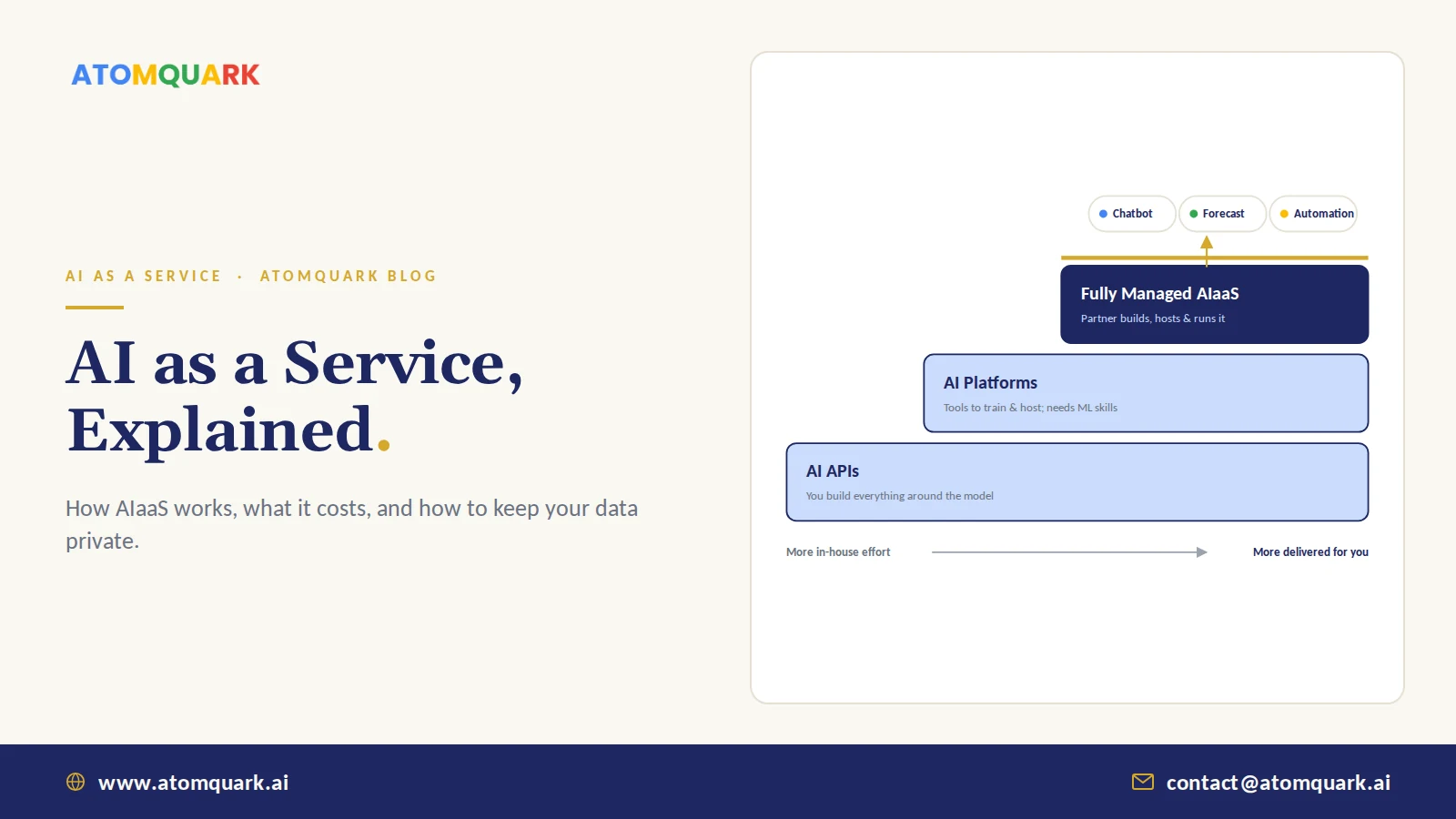
The Three Main AIaaS Delivery Models
- Public AI APIs. You call a commercial language model directly through its provider's API. It's fast to start and priced per token. Your team still builds everything around the model.
- AI platforms. Cloud AI platforms provide tools to train, deploy and host models. More control, but you need people who know how to use them.
- Fully managed AIaaS. A partner designs, builds, hosts and maintains the AI solution for your use case, often across several models. You define the problem and own the data. This is the model Atomquark offers through its AI as a Service practice, including on-premise hosting for companies that can't send data to public clouds.
What Can You Get Through AI as a Service?
The common building blocks:
- Conversational AI and chatbots for support, HR or sales. See what separates good ones in enterprise AI chatbots that deflect tickets.
- Generative AI for content, code and summarisation, tuned to your brand and terminology.
- Document Q&A and search using retrieval-augmented generation (RAG) over manuals, contracts and policies.
- Forecasting and prediction, such as demand planning. Atomquark's spare parts forecasting software runs ML demand forecasts across 70+ countries.
- Intelligent automation that combines AI with workflow tools to remove repetitive work.
- AI agents that complete multi-step tasks. Our guide to agentic AI for enterprise covers when they make sense.
AIaaS vs Building AI In-House: Cost and Time
This is where most decisions get made. Atomquark's AIaaS page compares the two approaches using its own delivery estimates:
- Time to production — Build in-house: 6 to 12 months. Managed AIaaS (Atomquark estimate): 4 to 8 weeks.
- AI/ML specialists needed — Build in-house: 5 to 10. Managed AIaaS: none in-house; provider manages it.
- Infrastructure cost — Build in-house: $50K to $200K per year. Managed AIaaS: scoped per customisation and assessment.
- Model updates — Build in-house: manual retraining. Managed AIaaS: continuous MLOps.
Treat these as planning ranges, not guarantees. Your numbers depend on data quality, integration count and compliance requirements.
Building in-house still makes sense when AI is your core product, when you already have a strong ML team, or when you need deep, long-term control over model research. For most companies using AI to improve operations, the managed route reaches value faster. The same logic applies to software generally, as we discuss in custom software vs off-the-shelf.
AIaaS Pricing Models Explained
Expect one or a mix of these:
- Usage-based: per API call, per token or per document processed. Cheap to start, harder to predict.
- Subscription: a fixed monthly fee for a defined scope, such as a chatbot handling a set volume.
- Project plus run fee: a build fee followed by a monthly managed-service fee for hosting and maintenance.
- Outcome-linked: fees tied to results, such as tickets resolved. Rare, and worth scrutinising.
Ask every provider how model usage costs are passed through. Token costs can grow quickly with agents and long documents, which is why LLM cost optimization should be part of the design.
Data Privacy: The Question That Decides Everything
Sending customer records, contracts or health data to a third-party model raises real compliance questions under laws such as the EU GDPR and India's Digital Personal Data Protection Act, 2023.
Three questions to ask any AIaaS provider:
- Where is the data processed and stored? Public cloud region, private cloud or your own servers?
- Is our data used to train shared models? The answer should be no, in writing.
- Can the solution run on small language models on-premise? For sensitive workloads, private and on-premise AI removes the need to send data out at all. Atomquark's AIaaS page lists on-premise deployment and SOC 2 and GDPR readiness among its options.
How to Choose an AI as a Service Provider
A short checklist we'd use ourselves:
- Production evidence. Ask for live systems, not demos. Atomquark points to live deployments such as its traffic enforcement system in Hazen, KSA and the HMD Global warranty and spares platform.
- Model flexibility. Avoid lock-in to one model vendor. Multi-model routing lets you switch as prices and quality change.
- Security posture. Identity controls, encryption, audit logs and alignment with frameworks like ISO 27001.
- Clear ownership. Who owns the prompts, fine-tuned models and integration code if you leave?
- Measurable success criteria. Agree up front on what "working" means.
Practical Example: Choosing an AIaaS Model for a Support Chatbot
Here's an illustrative scenario that mirrors the conversations we have most often. A 300-person electronics distributor wants an AI assistant that answers dealer questions about stock, pricing tiers and warranty terms. Their IT team is four people, none with machine learning experience.
Walking through the three models:
- Public API only: cheapest on paper, but someone has to build retrieval over the product catalogue, connect the ERP for live stock, handle authentication for dealers and monitor answers. With no ML skills in-house, the project stalls at the prototype.
- Cloud AI platform: more powerful, but it adds infrastructure the team can't operate.
- Fully managed AIaaS: a partner builds the assistant, grounds it in the catalogue and warranty policies, connects to the ERP through an API, and runs it. The distributor's team owns the content and the approval rules.
The deciding factors weren't the model or the price per token. They were team capacity and data sensitivity: dealer pricing is confidential, so the assistant runs on private infrastructure with a small language model handling routine questions and a larger model reserved for complex ones.
The lesson generalises. Decide who will own each layer (data, model, integration, operations) before you compare vendors.
Conclusion
AI as a Service lets you use AI the way you use electricity: you care about what it powers, not the power station. Start by deciding how much AI engineering you want to own, then match the delivery model to that answer and to your data sensitivity.
If you'd rather skip the hiring and infrastructure and go straight to a working solution, explore Atomquark's AI as a Service or contact the team to scope your first use case.
Frequently Asked Questions
What is AI as a Service with an example?
AI as a Service is AI delivered by an external provider rather than built in-house. For example, a retailer might use a managed AI chatbot that answers order questions, with the provider handling the model, hosting and updates.
What are the benefits of AI as a Service?
The main benefits are faster deployment, no need to hire a full AI team, lower upfront infrastructure cost, ongoing model maintenance by the provider and the ability to scale usage up or down as needs change.
Is AI as a Service secure for sensitive data?
It can be, if the provider offers private or on-premise hosting, encrypts data, does not train shared models on your data and supports your compliance requirements. Always confirm these points in the contract.
How much does AI as a Service cost?
Costs vary widely by scope. Usage-based APIs can start at a few dollars a month, while managed enterprise solutions are typically priced per project plus a monthly run fee. Ask for pricing tied to your expected volume.
What is the difference between AIaaS and SaaS?
SaaS delivers ready-made software applications. AIaaS delivers AI capabilities, such as models, predictions or agents, that are often customised to your data and embedded into your own products or workflows.
Can small businesses use AI as a Service?
Yes. AIaaS is often the most practical route for small businesses because it avoids hiring specialists and buying infrastructure. Starting with one narrow use case, such as a support chatbot, keeps costs predictable.