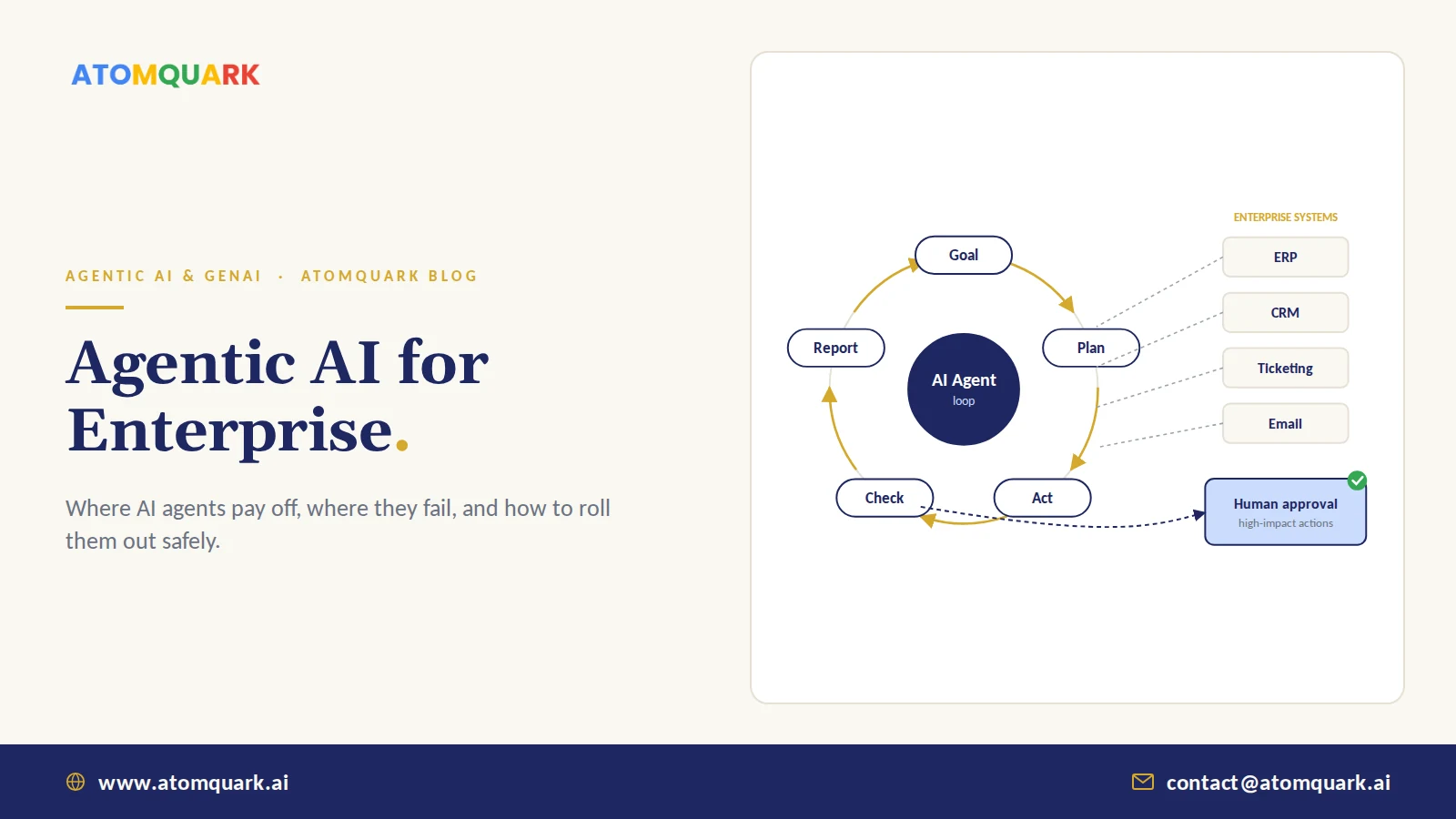
Agentic AI for enterprise means AI systems that can take a goal, break it into steps, use business tools (APIs, databases, email, ticketing systems) to carry those steps out, and check their own progress, with humans approving the decisions that matter. A chatbot answers. An agent acts.
That one difference is why every software vendor now claims to sell "agents," and why so many pilots stall. In a June 2025 forecast, Gartner predicted that over 40% of agentic AI projects will be cancelled by the end of 2027, citing rising costs, unclear value and weak risk controls. The same research also predicts that a third of enterprise software applications will include agentic AI by 2028.
Both things are true. Agents are real, and most early projects are pointed at the wrong problems. This guide is about telling those apart.
Quick answer: Use agentic AI where a task needs judgment across several systems and the cost of a wrong step can be contained. Use plain automation where the steps never change. Use a simple assistant where someone only needs information.
What Is Agentic AI? A Plain-Language Definition
An AI agent is a large or small language model wrapped in a loop. It receives a goal, decides on the next action, calls a tool, reads the result, and decides again until the goal is met or it hands off to a person.
Four capabilities separate an agent from a standard generative AI feature:
- Planning: it breaks "reconcile last month's vendor credits" into sub-tasks instead of waiting for step-by-step instructions.
- Tool use: it can query a database, call an API, fill a form or draft an email, usually through defined functions or standards such as the Model Context Protocol.
- Memory and context: it keeps track of what it has already tried within a task and can pull from company knowledge through retrieval.
- Self-checking: it evaluates intermediate results and retries or escalates when something looks wrong.
Agentic AI vs Generative AI vs RPA vs Chatbots
These terms get blurred, sometimes on purpose. Gartner calls the rebranding of old assistants and bots "agent washing." Here's how we separate them when scoping projects:
- RPA / rule-based automation — What it does: follows fixed steps exactly. Best fit: stable, high-volume, structured processes. Weak spot: breaks when screens, formats or rules change.
- Generative AI assistant — What it does: produces text, code or summaries on request. Best fit: drafting, summarising, searching knowledge. Weak spot: doesn't act; a human still does the work.
- Chatbot — What it does: answers questions in a conversation. Best fit: FAQs, simple support, guided flows. Weak spot: limited to scripted or retrieved answers.
- AI agent — What it does: plans and executes multi-step work using tools. Best fit: variable tasks spanning several systems. Weak spot: higher cost, harder to test, needs guardrails.
The honest takeaway from that comparison: many "agent" use cases are better served by a workflow with one or two AI steps in it. Our rule of thumb is simple: use the least complex pattern that solves the problem, and add autonomy only when a simpler workflow can't cope.
Where Agentic AI Pays Off: Enterprise Use Cases
The strongest use cases share three traits. The work is repetitive enough to matter, variable enough that fixed rules fail, and checkable, so a person or a system can verify the outcome.
IT and Customer Support Resolution
Support is the most mature area. An agent can read a ticket, classify it, look up the knowledge base, check the user's account status, run a safe fix such as a password reset, and close the loop. Atomquark's AI support desk software applies this pattern to L1 requests; the product page reports around 60% of tickets resolved automatically in its live deployment, with complex cases routed to the right agent. We've written separately about reducing MTTR with AI if support is your starting point.
After-Sales, Warranty and Spares Operations
After-sales is full of multi-system decisions: check eligibility, validate a claim, match it to stock, trigger a credit note. In the warranty platform Atomquark runs for HMD Global across 70+ countries, rules-based adjudication handles the structured part. Agentic layers fit around it, such as investigating claims that fail validation or chasing missing documents, before a human makes the final call. See automated warranty claim adjudication for how the rules layer works.
Finance and Procurement Back Office
Invoice exceptions, vendor onboarding checks and purchase-order matching all involve reading documents, comparing records and asking someone a question. Agents handle the gathering and comparing. People keep the approval.
Internal Knowledge Work
Research briefs, competitor scans, RFP first drafts and policy look-ups. These are low-risk, high-volume and easy to review, which makes them good training grounds for teams new to agents.
Where Agentic AI Fails (and Why Projects Get Cancelled)
Most failures we see in proposals and audits come from a short list:
- Agents pointed at deterministic work. If the steps never change, RPA or a script is cheaper, faster and easier to audit.
- No definition of "done." Without a measurable outcome (tickets closed, hours saved, error rate), nobody can tell whether the agent helped.
- Ungrounded answers. An agent that can't reach accurate company data will improvise. Grounding through retrieval-augmented generation is usually step one.
- Too much autonomy, too early. Letting an agent send payments or change production systems on day one is how pilots end in incident reviews.
- Runaway cost. Agents call models many times per task. Without routing and caching, the bill climbs quickly. Our guide to LLM cost optimization covers the fixes.
Guardrails: How to Keep AI Agents Safe and Auditable
Treat an agent like a new employee with system access. You wouldn't give a new hire admin rights and no supervisor.
- Least-privilege tool access. Give each agent only the APIs and permissions its task needs, using the same identity controls you apply to people. Our identity and access management guide explains the model.
- Human approval gates. Require sign-off for irreversible or high-value actions: payments, customer-facing messages, data deletion.
- Full logging. Record every tool call, input and output so you can reconstruct what happened.
- Prompt-injection defences. Agents that read emails or web pages can be manipulated by hidden instructions. The OWASP Top 10 for LLM Applications lists this as a leading risk.
- Spending and loop limits. Cap the number of steps and the cost per task.
These controls belong inside a wider AI governance framework, not bolted on after launch.
A Phased Rollout Plan for Agentic AI
Here's the sequence we'd follow if we were starting from zero tomorrow:
- Pick one process with a clear metric. Ticket resolution time, claim processing time, hours spent on a report.
- Map it and remove waste first. Automating a broken process just makes it break faster. Lean process mapping, the kind our technology and operations consulting team runs, comes before any model.
- Start as a copilot. The agent drafts and recommends; a person executes. Measure accuracy for a few weeks.
- Grant narrow autonomy. Let it act on low-risk steps, keep approval on the rest.
- Instrument and review. Track cost per task, error rate and escalation rate. Expand only when the numbers hold.
- Productionise. Move from notebook demos to monitored, versioned deployments, the MLOps discipline.
Build, Buy or Use AI as a Service?
You can build agents in-house with open frameworks, buy them inside SaaS products, or use a managed model. If you lack an AI engineering team, AI as a Service lets a partner build, host and run the agents while your data stays on infrastructure you control. Our explainer on what AI as a Service is compares the options.
Conclusion: Start Narrow, Prove Value, Then Scale
Agentic AI is not a strategy on its own. It's a tool for a specific kind of work: variable, multi-step, cross-system and checkable. Pick one process. Ground the agent in real data. Keep humans on the decisions that carry risk. And measure everything, because the projects that survive 2027 will be the ones that can prove what they saved.
If you want a second opinion on where agents fit in your operations, book an agentic AI use-case workshop with Atomquark. We'll tell you which ideas need an agent, which need a script, and which need neither.
Frequently Asked Questions
What is agentic AI in simple terms?
Agentic AI is AI that can pursue a goal on its own by planning steps, using software tools and checking results, rather than only answering a single question. A human usually sets the goal and approves high-impact actions.
How is agentic AI different from generative AI?
Generative AI creates content such as text, code or images when asked. Agentic AI uses generative models as its reasoning engine but adds planning, tool use and memory, so it can complete multi-step tasks across business systems.
Is agentic AI the same as RPA?
No. RPA follows fixed, pre-programmed steps and breaks when inputs change. AI agents decide their next step based on context, which suits variable work but makes them costlier and harder to test. Many solutions combine both.
What are the main risks of AI agents in business?
The main risks are incorrect actions from ungrounded reasoning, prompt injection through untrusted content, excessive system permissions, unpredictable costs and weak audit trails. Least-privilege access, approval gates and full logging reduce these risks.
Which enterprise processes suit agentic AI best?
Processes that are repetitive, vary from case to case, span several systems and have outcomes that can be checked. IT support, claims handling, invoice exceptions and research tasks are common starting points.
How long does it take to deploy an AI agent in production?
A narrow, well-defined agent can reach a supervised pilot in weeks. Full production with monitoring, governance and integrations typically takes a few months, depending on data readiness and the number of systems involved.
Do I need my own AI team to use agentic AI?
Not necessarily. Companies without in-house AI engineers often use AI as a Service, where a partner designs, hosts and maintains the agents while the business owns the process, data and approval rules.