
Enterprise API integration is the practice of connecting business applications, such as ERP, CRM, e-commerce, warehouse, finance and HR systems, through application programming interfaces so data moves between them automatically, accurately and securely. A strategy decides which integration patterns, tools, security rules and ownership model you'll use, so each new connection doesn't become a one-off project.
Every growing company hits the same wall. Orders are typed from the website into the ERP. Finance exports a spreadsheet to reconcile payments. Someone emails the warehouse because the stock numbers don't match. Each fix gets its own little script, and three years later nobody knows which script updates what.
That tangle has a name, integration spaghetti, and it's expensive. Here's how to avoid it.
Rule of thumb: Use APIs for requests that need an immediate answer, events for things other systems should know about, and batch for large volumes that can wait.
Why Enterprise API Integration Needs a Strategy
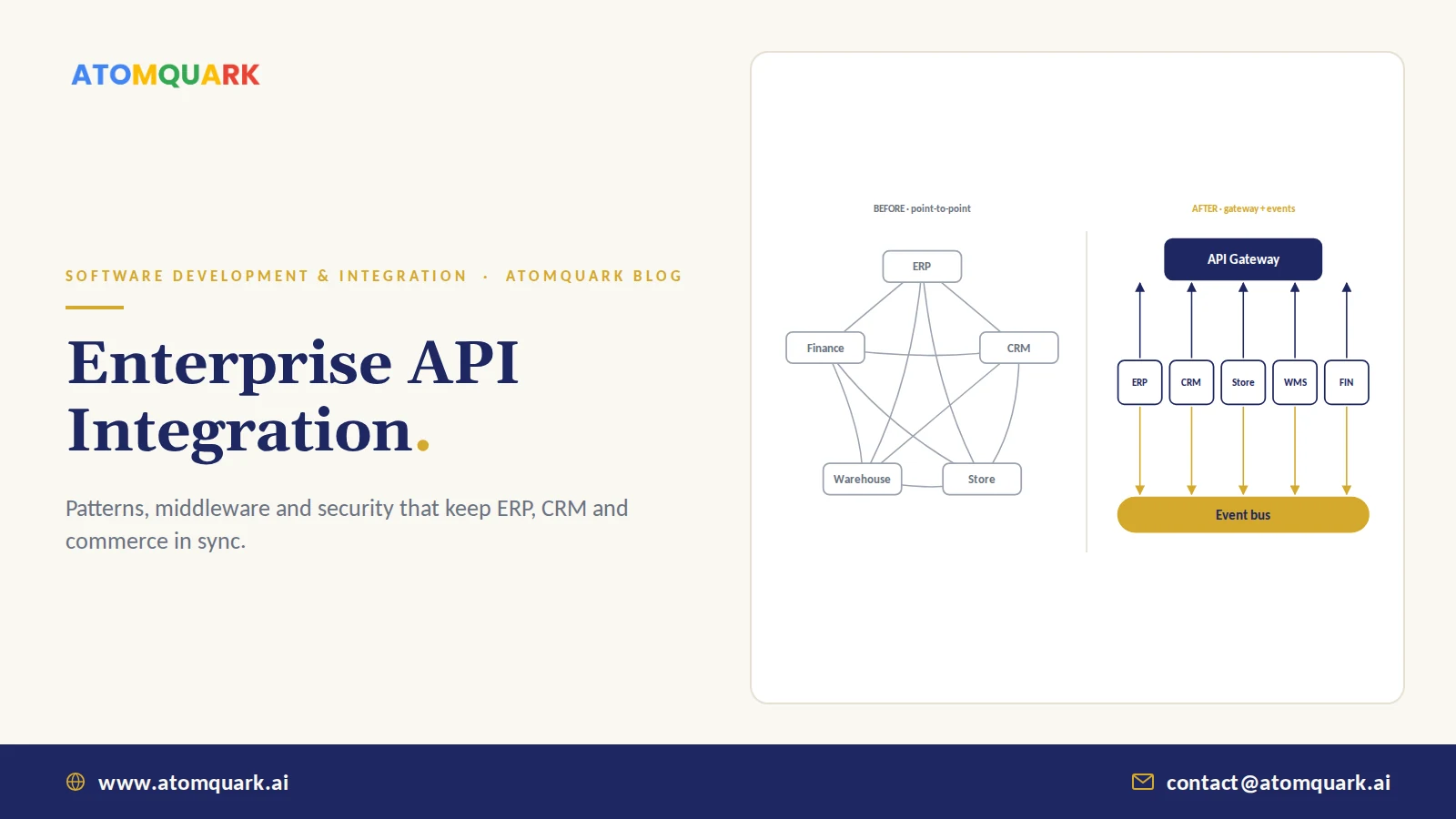
Without a strategy, integration costs grow faster than the number of systems: connecting 10 systems point-to-point can mean up to 45 separate links, each with its own failure modes. With a strategy, you get reusable connections, consistent security, clear monitoring and faster delivery of new features, because the plumbing already exists.
The Main Integration Patterns
Request/response APIs (synchronous)
One system asks, another answers immediately. Use it for checking stock before confirming an order or validating warranty eligibility. REST with JSON is the default today; SOAP remains common in older enterprise and banking systems and still works well where strict contracts are needed.
Event-driven integration (asynchronous)
A system publishes an event ("order shipped") to a message broker such as RabbitMQ or Kafka. Any interested system subscribes. Senders and receivers don't need to be online at the same time, which makes the whole landscape more resilient.
Batch and file transfer
Large nightly loads, financial postings and data warehouse feeds. Unfashionable, but often the right answer. The warranty management platform Atomquark runs for HMD Global, for example, generates finance-ready files for upload to SAP S/4HANA alongside real-time API integrations with other systems.
Real-time push
WebSockets or server-sent events for live dashboards. Atomquark's Activation Tracker uses SignalR WebSockets to update dashboards the moment a new device activation lands.
- REST API — Best for: immediate lookups and updates. Watch out for: tight coupling; cascading failures.
- SOAP — Best for: legacy and strictly contracted systems. Watch out for: verbose; heavier tooling.
- Events / message queue — Best for: notifying many systems; resilience. Watch out for: harder to trace; eventual consistency.
- Batch / file — Best for: high volume, non-urgent. Watch out for: delays; error handling per record.
- WebSocket — Best for: live dashboards and alerts. Watch out for: connection management at scale.
Point-to-Point vs Middleware vs API Gateway
Point-to-point is fine for two or three systems. Beyond that, consider:
- Integration platforms and iPaaS: integration frameworks, low-code integration tools or workflow tools such as n8n centralise transformations and routing.
- API gateways: a single managed entry point for authentication, rate limiting, versioning and analytics.
- Event bus: a broker that decouples publishers from subscribers.
Most mature architectures combine a gateway for synchronous APIs with a broker for events.
API Integration Best Practices
- Design contracts first. Define APIs with the OpenAPI Specification before writing code, so teams can build in parallel.
- Version from day one. Breaking changes go into a new version; old versions get a deprecation date.
- Make operations idempotent. Retrying "create order" shouldn't create two orders. Use idempotency keys.
- Handle failure explicitly. Timeouts, retries with backoff, circuit breakers and dead-letter queues for messages that can't be processed.
- Define a master for each data type. Decide which system owns customers, products and prices. Duplicate masters cause most data quality problems.
- Log with correlation IDs. Trace a single order across every system it touches.
- Monitor business outcomes, not just uptime: orders synced, failures per hour, time to sync.
API Security: Don't Skip This
APIs are now a primary attack surface. The OWASP API Security Top 10 lists the most common flaws, led by broken object-level authorisation, where a user can access another user's records by changing an ID.
Minimum controls: strong authentication (OAuth 2.0 or certificates for system-to-system), authorisation checks on every object, TLS everywhere, rate limiting, input validation, secrets in a vault, and API access tied into your identity and access management.
Integration During Modernisation
Integration strategy matters most when you're replacing systems. A well-designed API layer lets you swap a legacy ERP behind the scenes without rebuilding every connection, which is the approach described in our legacy modernization and ERP migration guide. Clean integrations are also what make AI agents useful: an agent can only act on systems it can reach safely.
Practical Example: Connecting an Online Store, ERP and Warehouse
An illustrative mid-size retailer runs an e-commerce site, an ERP for finance and inventory, a third-party warehouse system and a CRM. Today, orders are exported every few hours, and overselling happens weekly.
A cleaner architecture:
- Ownership: ERP owns products, prices and stock; the store owns carts and checkout; the CRM owns customer contact preferences.
- Synchronous API: at checkout, the store calls an inventory API through the gateway to reserve stock. Timeout after two seconds and fall back to "confirm by email" rather than failing the order.
- Events: an "order placed" event goes to the message broker. The ERP, warehouse and CRM each subscribe and process it at their own pace. If the warehouse system is down for maintenance, messages wait in the queue instead of being lost.
- Batch: a nightly settlement file goes from the payment provider to finance.
- Idempotency: every order carries a unique key, so retries never create duplicates.
- Monitoring: a dashboard shows orders placed versus orders received by each system, with alerts on any gap.
The overselling stops because stock is reserved in real time, and the batch delays disappear for everything except the flows where a delay is harmless.
Good integration is invisible: orders flow, stock matches, finance closes on time. Getting there means choosing the right pattern for each flow, putting a gateway and broker in the middle once you pass a handful of systems, designing contracts first, planning for failure and securing every endpoint.
Atomquark's IT consulting and custom software development teams design and build integrations across REST, SOAP, WebSocket, RabbitMQ and enterprise platforms. Plan your integration architecture with us.
Frequently Asked Questions
What is enterprise API integration?
Enterprise API integration connects business applications such as ERP, CRM and e-commerce systems through APIs so data flows between them automatically and securely, without manual re-entry or file exports.
What is the difference between REST and SOAP APIs?
REST is a lightweight architectural style that typically uses JSON over HTTP and is the modern default. SOAP is a stricter XML-based protocol with formal contracts, still common in legacy enterprise, banking and government systems.
When should I use a message queue like RabbitMQ?
Use a message queue when several systems need to react to the same event, when senders and receivers should not depend on each other being online, or when you need to absorb spikes in volume reliably.
What is an API gateway?
An API gateway is a single managed entry point for APIs that handles authentication, rate limiting, routing, versioning and monitoring, so these concerns are not reimplemented in every service.
How do I integrate ERP with CRM?
Decide which system owns each data type, map the fields, choose real-time APIs for urgent updates and events or batch for the rest, add error handling and monitoring, and test with real data before go-live.
What are the biggest API security risks?
According to the 2023 OWASP API Security Top 10, leading risks include broken object-level authorisation, broken authentication, broken object property-level authorisation, unrestricted resource consumption and broken function-level authorisation.